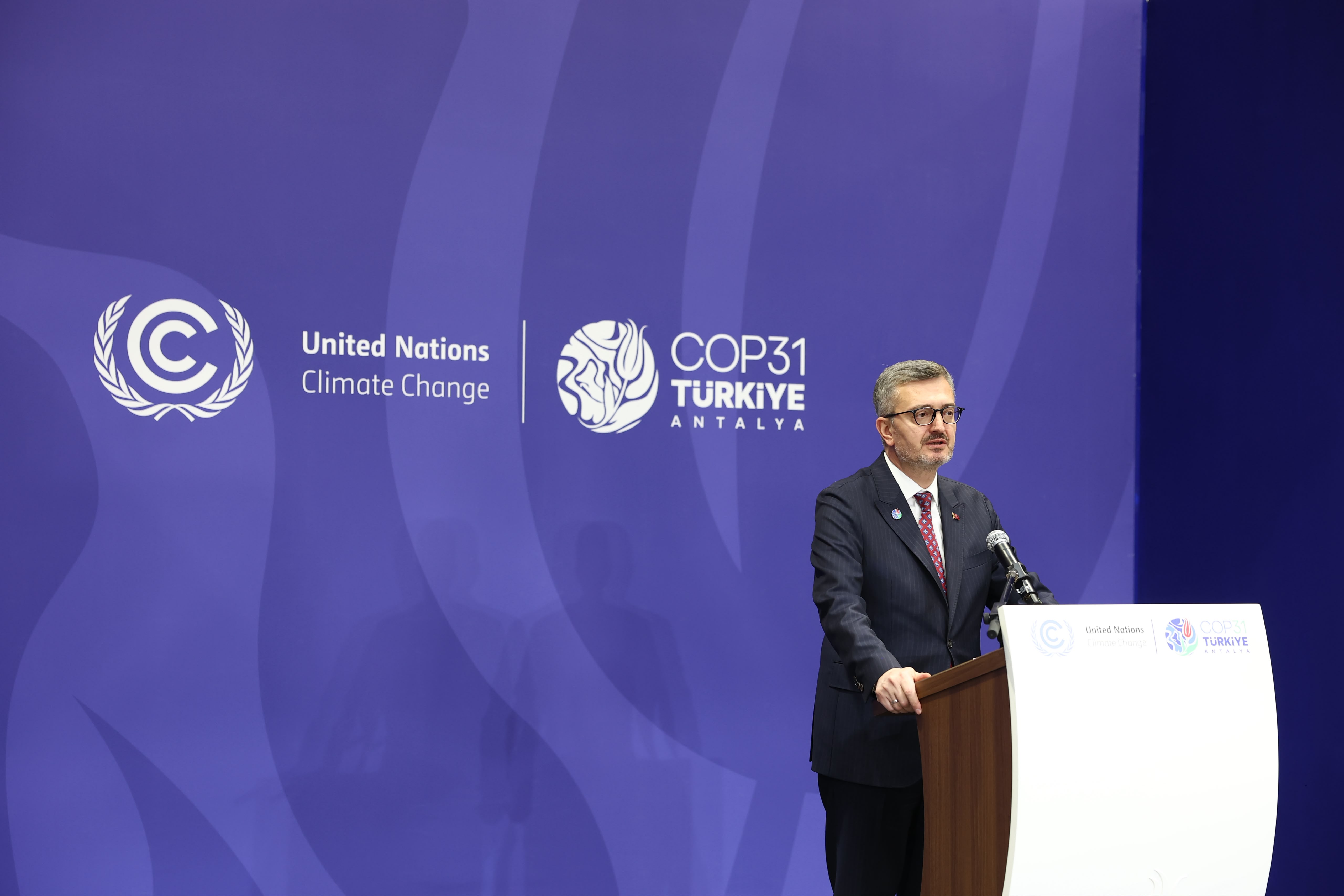
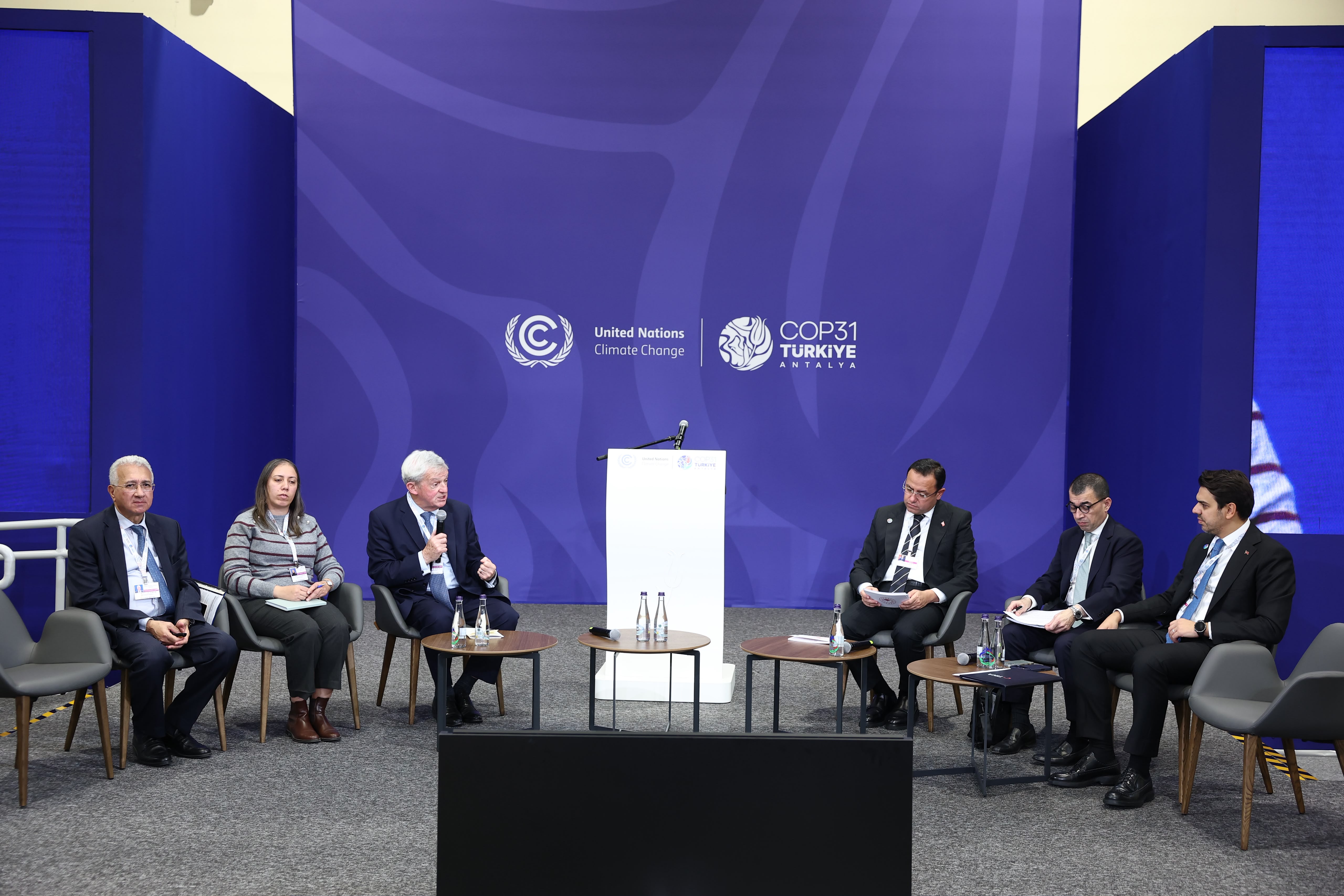
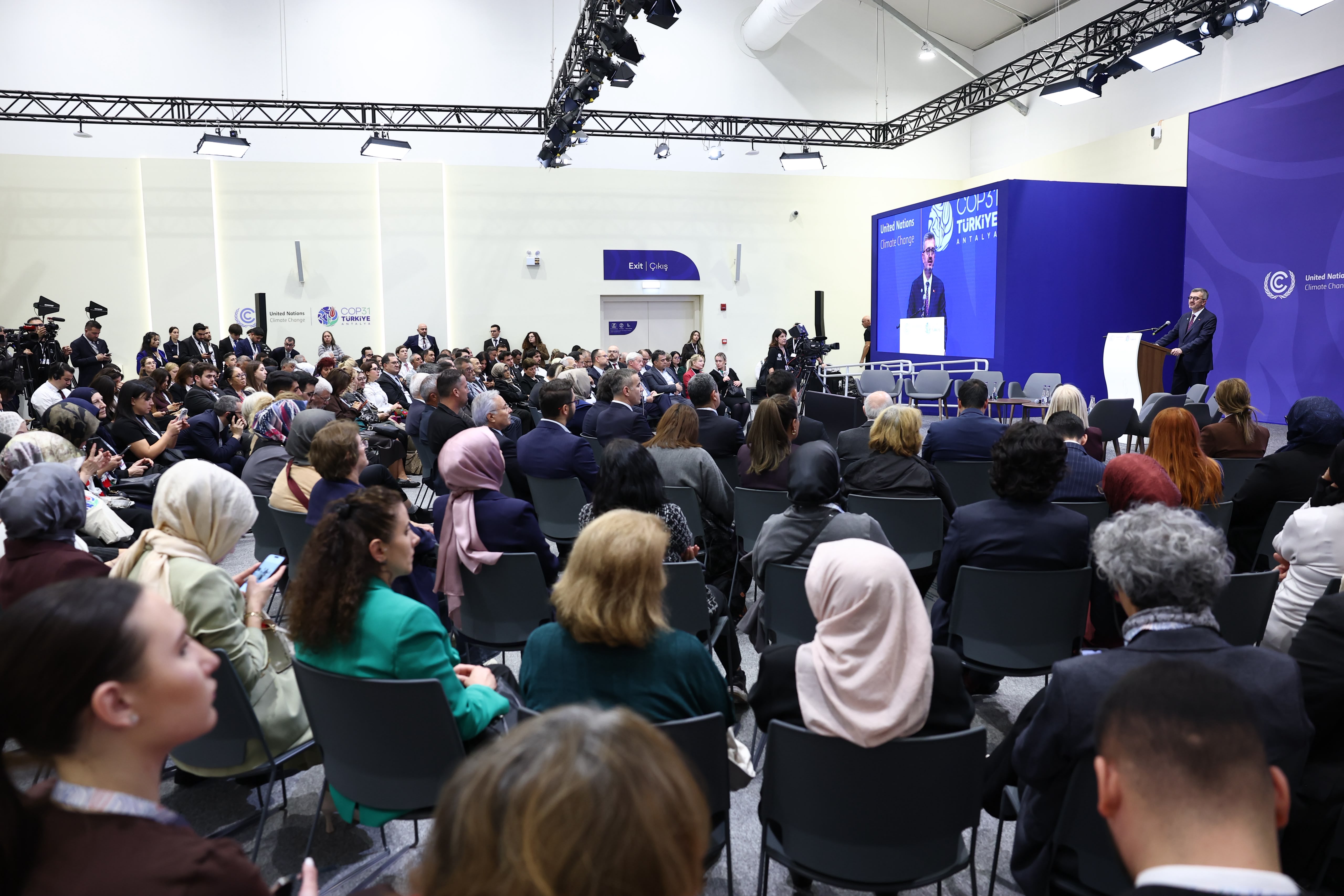
Presidency's Head of Communications Burhanettin Duran attended the panel titled “Connecting Energy, Agriculture and Climate Action: Building Resilience Through International Partnerships”, held in the Special Event Room in the Blue Zone as part of the 31st Conference of the Parties to the United Nations Framework Convention on Climate Change (COP31), hosted by Türkiye in Antalya.
Head of Communications Duran, noting that they were pleased to welcome the participants to Türkiye on the occasion of COP31, expressed his hope that the panel would contribute to a better future for countries and for humanity.
Pointing out that, for much of the last century, humanity’s greatest objective was to produce more, grow faster and achieve higher levels of prosperity, Head of Communications Duran said, “Today, we are facing the very consequences brought about by this objective.” The question before us is how to preserve natural resources while continuing economic development. In this context, I would like to address the relationship between energy, agriculture and climate change. The global population today stands at more than eight billion. Projections indicate that this figure will continue to rise in the second half of the century, eventually exceeding ten billion."
Head of Communications Duran pointed out that the issue goes far beyond population growth, emphasising that the vast majority of the world’s population lives in urban areas and that industrialisation continues to shape the way people work.
Head of Communications Duran drew attention to the expansion of cities and said:
“Our patterns of consumption are changing. And our demand for food and energy continues to increase. Meanwhile, the pressure on our natural resources continues to grow. We are therefore faced with a fundamental question: how can we meet today’s needs without depleting tomorrow’s resources? Energy is undoubtedly essential at every stage of food production. Agriculture depends on a reliable energy supply at every stage, from irrigation and harvesting to processing, storage and transport. As energy prices rise, food prices rise too. When people struggle to access food, economic stability and social peace come under pressure. A crisis originating in one sector can rapidly develop into a crisis in another. This is why we cannot formulate energy policies without taking agriculture into account. Nor can we develop agricultural policies without accounting for climate change. We need a holistic approach. We must preserve our water, maintain the fertility of our soil, and at the same time reconsider our patterns of 'production and consumption'. We cannot build a sustainable future on an unsustainable model of consumption.”
“I attach great importance to climate diplomacy"
Head of Communications Duran also drew attention to the impact of climate change on international relations and stated that no country can isolate itself from the consequences of the global climate crisis.
Stating that he therefore attaches great importance to climate diplomacy, Head of Communications Duran said, "In my view, climate diplomacy has become an indispensable part of foreign policy and, at the same time, a matter of global justice. We know that countries contribute to climate change to differing degrees. However, we also know that their capacities to deal with the consequences vary considerably as well. Some of the countries most vulnerable to climate change are those that have contributed the least to the problem. We cannot ignore this reality. Developing countries need access to climate finance, technology, and the means to build their own capacities. We must ensure that climate action does not deepen existing inequalities between countries."
Head of Communications Duran stated that a shared future requires shared responsibility, while emphasising that shared responsibility does not mean equal responsibility and that there is a need for fair international negotiations that respect countries’ national priorities and differing capacities.
Emphasising that this understanding is closely linked to President Recep Tayyip Erdoğan’s call for global justice, Head of Communications Duran continued:
Under our President’s leadership, Türkiye resolutely advocates a fairer international system. We promote dialogue, mediation and peaceful solutions to global challenges. We apply the same approach to climate diplomacy. We must also remember that peace and environmental security are closely interconnected. The destruction caused by Israel’s attacks on Gaza is a painful reminder of this reality. Alongside immense human suffering, the destruction of infrastructure and natural resources is also causing serious environmental consequences. We cannot speak of a sustainable world while remaining indifferent to the destruction of human life and the environment.''
Türkiye’s approach to climate change and the concrete steps it has taken
Head of Communications Duran noted that Türkiye’s approach to these global challenges is rooted in the values of its civilisation, stating that they regard human life as sacred, see nature as a sacred trust, and consider avoiding waste a moral and religious responsibility. He added:
''Our Prophet Muhammad (peace be upon him) taught us to plant the sapling in our hands even if the Day of Judgment were about to come. He also taught us to avoid wasting water, even if we are standing beside a flowing river,'' Head of Communications Duran continued as follows:
''We believe that our responsibility towards nature also extends to future generations whom we will never meet. This understanding guides Türkiye’s long-term development vision. Our country ratified the Paris Agreement in 2021. Under the leadership of our President, we aim to achieve the net-zero emissions target by 2053. We are taking concrete steps towards achieving this goal. Our first Climate Law entered into force last year. This law has strengthened the legal framework for our efforts to combat climate change. Another concrete example is the Zero Waste Movement, launched under the leadership of First Lady Emine Erdoğan. What began as an initiative in Türkiye has quickly evolved into a global environmental movement.''
Reminding that, at Türkiye’s initiative, the United Nations General Assembly had declared 30 March as the International Day of Zero Waste, Head of Communications Duran said that this development was an important achievement in terms of contributing to strengthening global climate awareness and Türkiye’s climate diplomacy.
Stating that the philosophy underpinning the zero waste approach is simple yet powerful, Duran said, ''Every bit of food we waste also represents a waste of water, energy and human labour. Reducing waste, conserving our resources and reintegrating materials into the economy are fundamental elements of the fight against climate change.''
The communication dimension of the climate crisis
Addressing the communication dimension of the climate crisis, Head of Communications Duran said:
''Even the best climate policies cannot succeed unless they are understood and embraced by society. We cannot achieve lasting transformation without engaging society in this process. For many years, climate communication was largely the domain of scientists, experts and environmental organisations. Of course, we all recognise that their work remains indispensable. However, we believe that scientific knowledge must become part of public debate. This knowledge must be communicated in a language that people can understand. In addition, we are facing another serious challenge in today’s information environment. Years of scientific research can be discredited by a misleading video lasting less than a minute. Complex policy decisions can become targets of disinformation campaigns before they are even understood by the public. As the Directorate of Communications, we work to safeguard the public’s access to accurate information. We are working with media organisations, academia and civil society to strengthen media and digital literacy on climate issues. In my view, effective climate communication is about more than simply correcting misinformation.''
Head of Communications Duran also stated that this requires building trust, listening to people’s concerns and explaining how climate policies affect their lives.
Noting that while climate policies may be negotiated in conference halls, their success will be determined in people’s daily lives, Head of Communications Duran added: ''Türkiye’s vision for COP31 is built on dialogue, consensus and action. As we continue our discussions in Antalya, we must remember that the true measure of our success will be what we achieve after COP31. What the world needs is not merely more promises, but the political will to fulfil them.''
The panel session followed Head of Communications Duran’s speech.