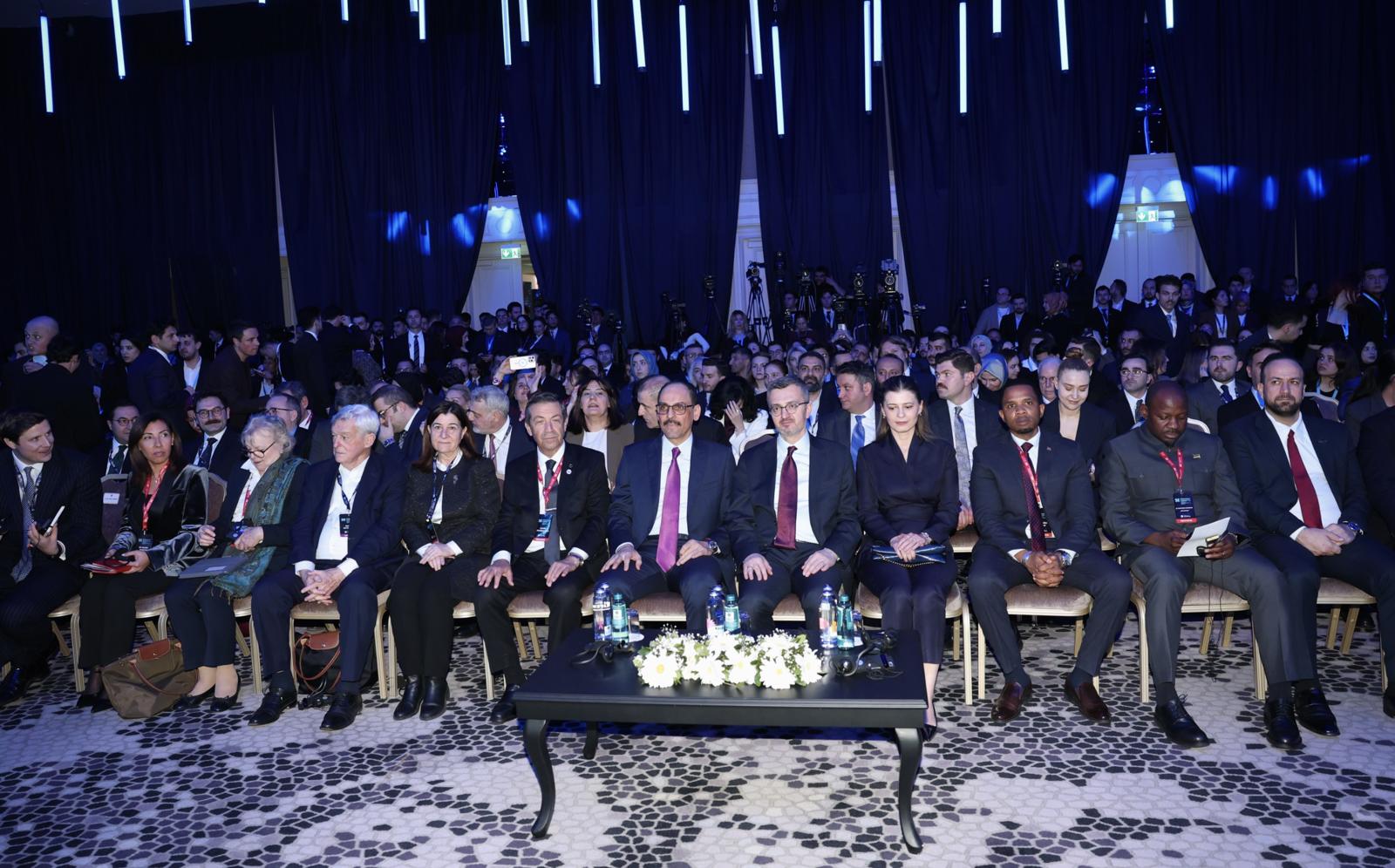
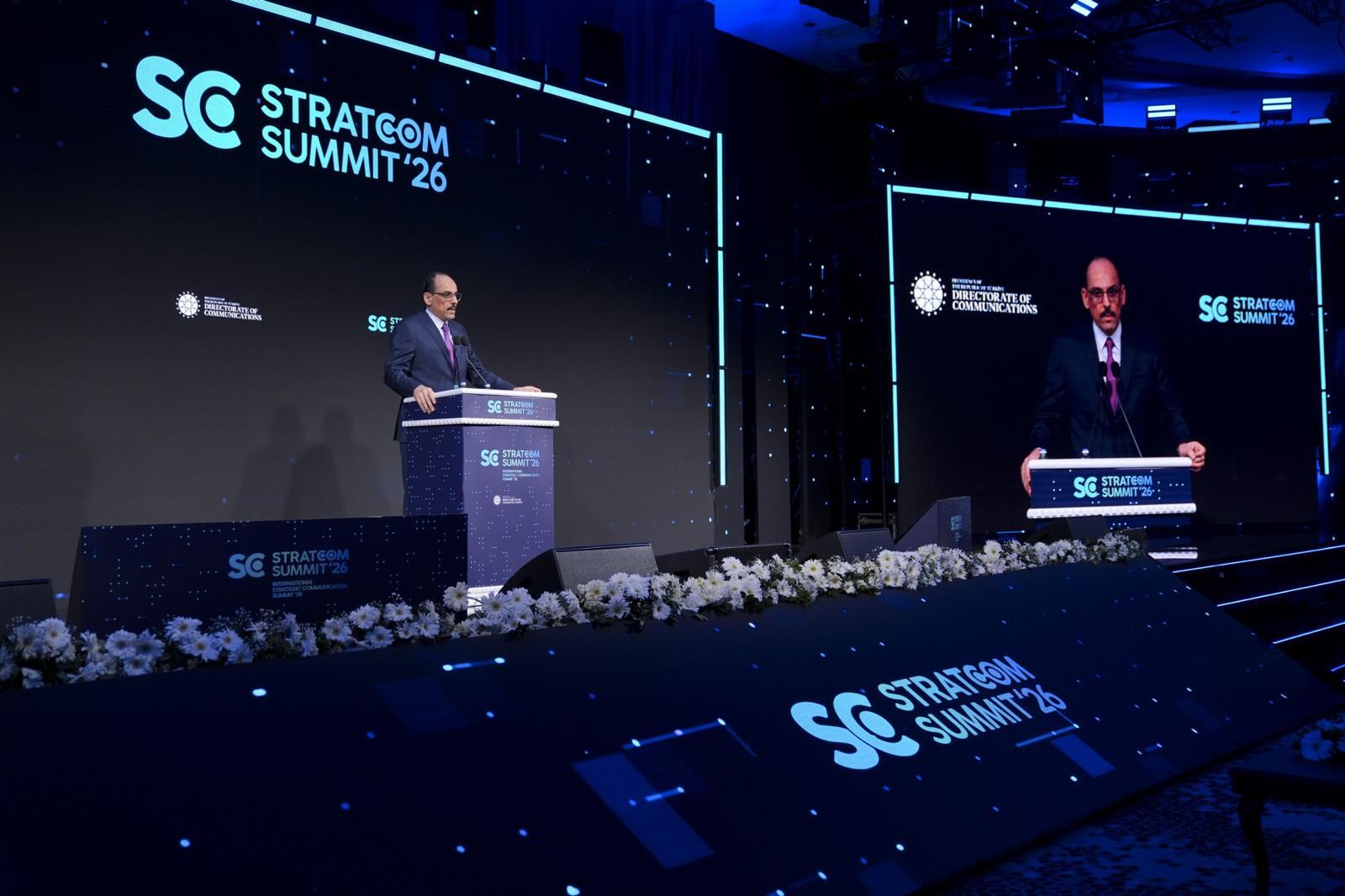
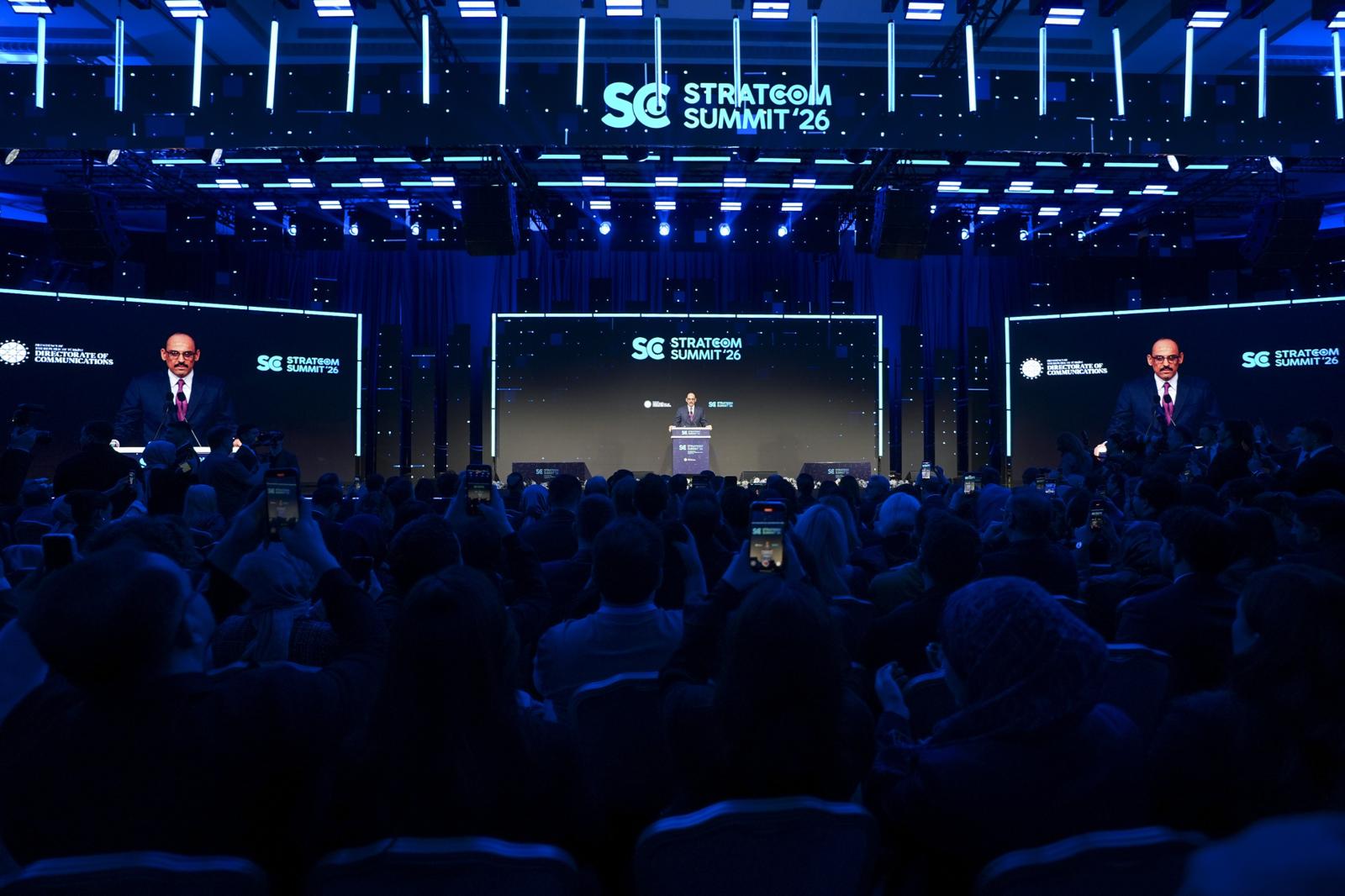
Director of the National Intelligence Organisation (MIT) İbrahim Kalın delivered remarks at the session titled “A New Paradigm in Communication: Information, Power, and Narrative,” held within the framework of STRATCOM 2026, organised under the theme “Disruption in the International System: Crises, Narratives, and Search for Order.”
In his address, Kalın noted that since the pandemic, the world has been passing through multiple critical thresholds, crises, and ruptures.
He underlined that the Russia–Ukraine war has entered its fifth year, with no clear outlook yet as to how it will conclude. He further stated that Israel’s attacks on Gaza, ongoing since October 2023, continue unabated.
“While our efforts to establish peace in Gaza are ongoing, Israel’s violations, as well as its policies of occupation and annexation, continue without interruption,” Kalın said.
Emphasising that the repercussions of the Syrian revolution continue to be felt across the region, Kalın stated:
“The 12-day Israel–Iran war that took place in June last year bore a character that both tested and revealed the actual conditions of the conflict we are currently facing. At present, we find ourselves in the midst of the Israel–United States–Iran war, which began on 28 February and has now been ongoing for one month. Under the leadership of our President, the Minister of Foreign Affairs, the Minister of National Defence, the Directorate of Communications, all other relevant stakeholders, and we have made intensive efforts from the outset to prevent this war from breaking out. On every occasion, we have underlined that a global system grounded in unpredictability, fragility, and the arbitrary use of power can only generate further crises and wars, and we have made every effort to prevent such conflicts and destruction. Today, as we stand in the midst of this war, we have been making intensive efforts over the past month both to bring it to an end and to ensure that Türkiye remains outside this conflict.”
Kalın emphasised that these efforts continue without interruption, stating:
“As of today, we are further intensifying our efforts to prevent the conflict from spreading across the entire region, from becoming more destructive, and from causing lasting damage for the future. However, regrettably, this regional war initiated by Israel is rapidly evolving into a global crisis and, in the words of our President, into ‘a war for which all 8 billion people pay the price’—is on the verge of becoming a reality. Our foremost priority is to ensure that this war comes to an end as soon as possible.”
“We act with full awareness of who is a friend and who is an adversary”
İbrahim Kalın went on to say,
“Alongside this major war, I must also underline that a great fire of discord is being ignited in our region. One of the intended outcomes of this war is not merely the elimination of Iran’s nuclear capacity; far more dangerously, it is the laying of the groundwork for a fratricidal conflict—a prolonged cycle of hostility among the region’s founding peoples, namely Turks, Kurds, Arabs, and Persians, that could endure for decades. As Türkiye, I would like to stress that we will remain on full alert and resolutely counter such attempts.
Türkiye has never been, and will never be, a party that fuels the flames of discord. If necessary, we will take the fire into our own hands and extinguish it ourselves, but we will never add fuel to it. We will continue to stand firmly against those who seek to inflame division, guided by our own dynamics, values, leadership, and national priorities. We act with full awareness of who is a friend and who is an adversary. I would like to reiterate once again that Türkiye will not depart from this course.”
Emphasising that the war against Iran lacks any legal basis under international law, Kalın stated that there is hardly any need to reiterate this point. He continued,
“However, we are fully aware that those who initiated this war do not intend to limit it to Iran alone. Through faits accomplis in Lebanon, Syria, the Palestinian territories, and elsewhere, they seek to create new realities on the ground and pursue policies of destruction, annexation, and occupation. Recent developments in Lebanon, in particular, indicate an attempt to create a fait accompli similar to what occurred in the Golan Heights in 1974, and to transform it into a policy of destruction, annexation, and occupation. We are intensifying our efforts to prevent this.”
Kalın added:
“As Türkiye, I would like to underline that we will not allow the fundamental rights of Palestinians to be stripped away through faits accomplis, not only in Lebanon but also in the Palestinian territories, nor will we permit the violations taking place in Gaza and the West Bank to be ignored. As a result of the sequential and cascading developments in this war, the conflict has now spread beyond Iran to encompass the entire Gulf region. Just as the attacks against Iran are wrong, we must also state clearly that attacks targeting the Gulf region do not serve any constructive purpose. In all our engagements and consultations with our friends and brotherly countries in the Gulf, we emphasise the need to pursue an approach grounded in the region’s own dynamics in order to bring this war to an end as soon as possible.”
“We must never forget who initiated the war”
Expressing his condolences for those who lost their lives in Iran and across the region, Kalın stated that they would continue to exert all efforts to ensure that such suffering does not recur.
“While the attacks carried out by Iran against Gulf countries are undoubtedly unacceptable, we must never lose sight of who initiated this war. Therefore, pressure must be increased on Israel, and efforts must be concentrated on the actor that started the war in order to prevent it from escalating into a broader regional conflict and a global crisis,” he said.
Kalın also underlined that, under the leadership of President Recep Tayyip Erdoğan, intensive efforts have been underway for days to establish a negotiation table:
“We are being asked every day: ‘Will there be talks? Will negotiations take place? Will a table be established?’ We fully support the initiative and the helping hand extended by our Pakistani brothers in this regard. What is needed is the formation of a suitable ground for these talks to take place. We have no doubt whatsoever that our Pakistani brothers will carry out an effective and capable role in this process.”
Kalın went on to say:
“As was the case before the war, and since its outbreak, we have observed that Israel has consistently sought to sabotage every attempt at initiating negotiations, opening channels of dialogue and communication. Most recently, through the attacks it has carried out over the past two days, it is once again exerting intense efforts to undermine and render these initiatives ineffective. As I have previously underlined, we will continue to make every possible effort—day and night, without interruption—to bring this war to an end. Once the war is over, we will also need to undertake efforts to swiftly repair any lasting damage in the region and to prevent further long-term harm by establishing a security architecture grounded in the region’s own dynamics.
As we manage this process, under the leadership of our President and in coordination with all our relevant institutions, we are drawing important lessons for our country’s security, strategic positioning, and regional perspective. In light of these lessons, we are strengthening our country’s security architecture and enhancing our resilience.”
Kalın stated that, since the 1970s, postmodernist thinkers have argued that the era of grand narratives—such as reason, science, enlightenment, progress, religion and society—has come to an end, suggesting instead that the course of humanity would continue through more micro-level relations and histories centred on identity, gender, ethnicity and social classes.
İbrahim Kalın noted, however, that when examining what has replaced grand narratives such as reason, enlightenment and science, it is evident—contrary to postmodernist expectations—that rather than a new coherent narrative, discourse and practice have come to be dominated by consumption-driven capitalist modes of production and a culture of exhibition.
Emphasising that postmodernism’s critique of classical modernity has made important contributions in terms of softening its sharper edges, Kalın noted:
“However, when we look at the concepts introduced with postmodernism, we are confronted with a new web of problems. With the widespread use of notions such as the denial of truth, the instrumentalisation of knowledge, the virtualisation of reality, the reduction of existence into a malleable commodity, the loss of meaning in knowledge, and the erosion of politics, we have entered a period of confusion. None of these has made the world more rational, freer or more just. On the contrary, we have entered a darker period in which irrational, darker and anti-freedom forces have come to the fore—almost confirming Freud’s projections about the subconscious. We have reached a point where some now refer to this as a ‘dark enlightenment.’”
Stating that knowledge alone is never sufficient, Kalın said, “We must complement knowledge with judgement and information with wisdom. One of the greatest misconceptions of our time is that what we call the ‘age of knowledge’ is, in fact, an age of information and data. We are living in a time when information is abundant, knowledge is diminishing, and wisdom is disappearing. Every day, millions—even billions—of data points are produced, yet their meaning, substance and direction remain unclear. We are faced with an accumulation of data—an informatics crisis that fails to offer solutions to our problems. The mere production of information is not sufficient for humanity to achieve its goals. Knowledge alone is not enough; knowing is not enough—we must also possess wisdom.”
“We are unable to establish the relationship between information and being, and between truth and information”
Stating that truth is information that conveys the essence of things as they are, Kalın said that any statement that does not meet this criterion constitutes a claim that must be proven, and that information becomes truth when it evolves into a conception aligned with the reality of being.
Drawing attention to the close relationship between truth and being since knowledge cannot be conceived independently of the reality of things, Kalın stated, “However, at the point we have reached through the processes of modernism and postmodernism, we have severed the link between information and truth, as well as between truth and being. We now live in an age in which information is instrumentalised, truth is rendered arbitrary, and existence is assumed to be constructed and shaped according to our own designs. As a result, we are unable to establish the relationship between information and being, and between truth and information.”
Stating that the reduction of the conception of being to a commodity is directly linked to modernity’s desire to control everything, Kalın continued:
“The point to which the modern world has brought us—and the conception of being imposed by hypermodernity—is that of a controllable existence. In order to control, everything must be rendered quantitative and transformed into something calculable. Anything that cannot be subjected to such quantification ceases, in effect, to exist for you. You only exercise dominion over that which you can control. Consequently, the purpose of information has increasingly become control itself. In this context, we must re-embrace the concept of truth, reposition information on a sound footing, and redefine our conception of being within a proper framework.
In particular, in the face of postmodernism’s anti-realist tendencies that deny truth and reality, and against today’s post-truth inclinations, we will continue to defend truth. Against irrationalism, we will uphold reason grounded in firm foundations; against attempts to enslave reason, we will defend freedom; against mechanisation, we will defend the human being; and against dark enlightenment, we will advocate a deeper enlightenment. We will insist that these are not relative, arbitrary, contextual, class-based or political constructs, but absolute, binding and universal values.”
“Our principal endeavour is to articulate our story in a universal language”
Emphasising that communication is not merely about transmitting information and messages but also about constructing meaning and providing direction, İbrahim Kalın said, “Divine messages—the sacred scriptures revealed to us—are each a message and a form of divine communication. However, their ultimate purpose is to construct meaning and to provide guidance for our lives. Likewise, the primary purpose of communication is to construct meaning and to offer direction. Communication is therefore also an effort to build meaning, to chart a course and to find direction.”
Stating that one of the fundamental challenges faced for many years by the Islamic world, including Türkiye, is the lack of awareness of its own narrative, Kalın continued:
“That which you do not name does not belong to you. A story you do not name is not your story. Even when you use your own words but rely on the grammar of others, you are not truly using your own language. Within another syntax—within another linguistic universe—you merely exhaust your own words. What is required, however, is to construct your own syntax, your own grammar and your own semantics simultaneously. Attempting to force words into that syntax does not provide a more authentic or realistic mode of expression. That which you do not narrate remains merely an occurrence. Events become lasting narratives only when they are told.”
Kalın stated that they will continue to protect and liberate both reason and the human spirit against all distortions of dark enlightenment, capitalist consumption models and the culture of exhibition. Emphasising that they will remain vigilant against attempts to create enemies and will thwart such efforts, Kalın said, “As Türkiye, we will continue on our path without separating information from truth, truth from being, power from right and justice, story or narrative from meaning and direction. Our principal endeavour is to articulate our story in a universal language while recognising that our story does not belong solely to a particular group, faction, region or city, but to our entire geography and, indeed, to all humanity. With this awareness, we will share it with all those who have the will, the intellect and the openness to listen. For this reason, we will build, tell and share our story so that our narrative may be enriched through engagement with others.”