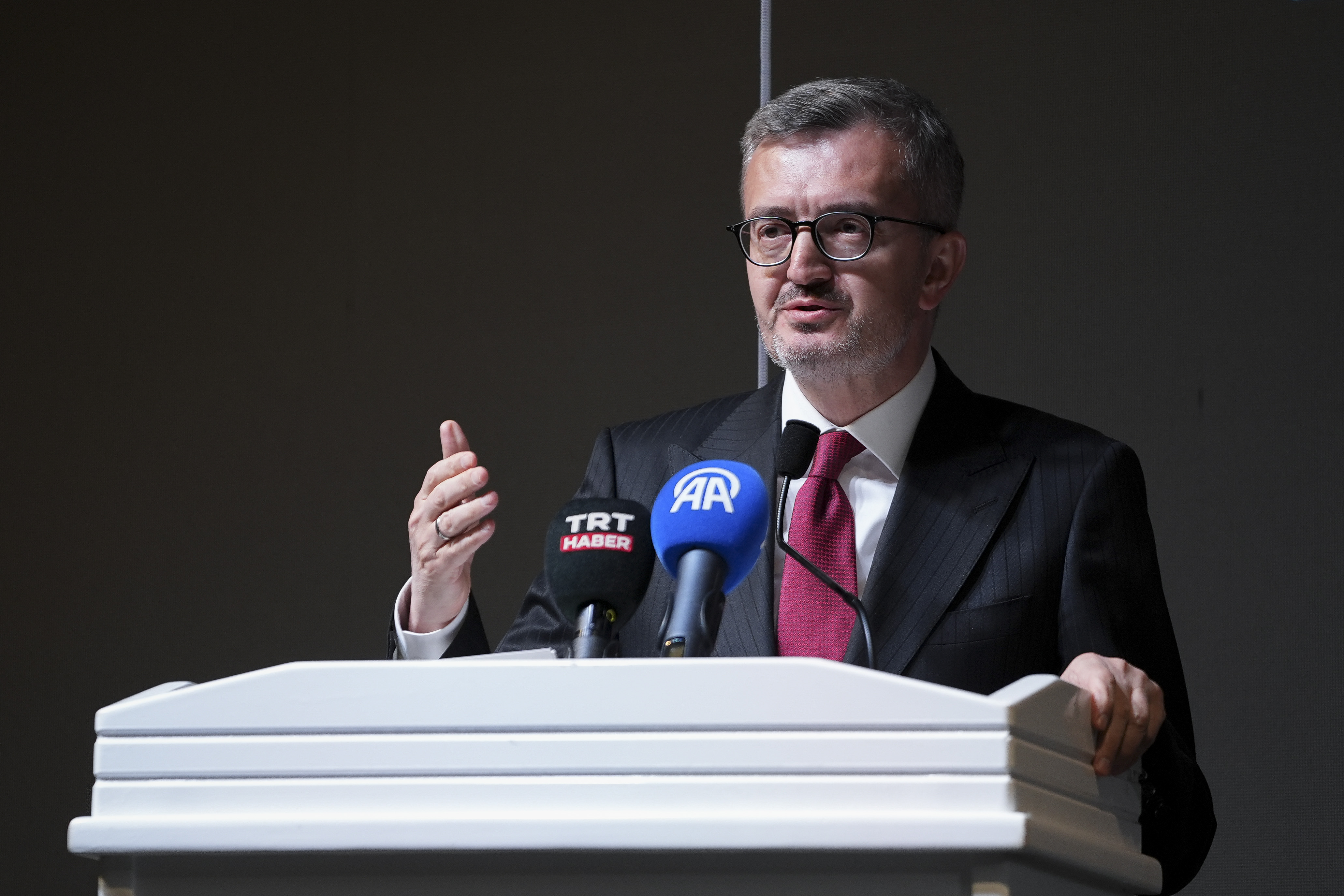
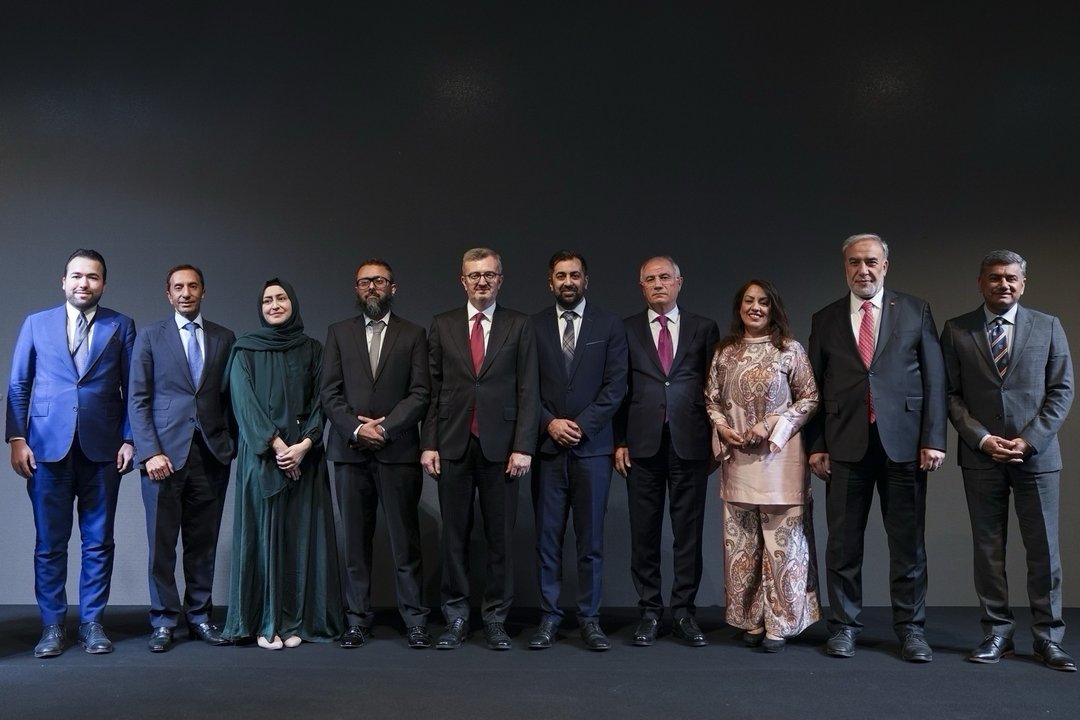
Addressing the Muslim Impact Forum (MIF) 2026, held at a hotel venue in Ataköy, the Presidency's Head of Communications, Burhanettin Duran, stated that it was a great pleasure to welcome all participants in İstanbul, a city that has long been one of the leading centres of Islamic civilisation.
Pointing out that the world is currently undergoing a profound transformation, Head of Communications Duran remarked that two decades ago, this might have been perceived as a typical shift in the international system.
Emphasising the gravity of the current situation, Head of Communications Duran said, ''Wars, genocides, pandemics, and the growing loss of trust in international institutions and norms show that we have crossed a critical threshold. We are living through a true turning point. Yet the real challenge is this: the international community, and the institutions once considered the pillars of the global system, have no clear vision of what comes next."
Head of Communications Duran highlighted that the current picture consists only of signs, noting that the first sign is clear and that great powers no longer assume great responsibility, while superpowers are increasingly unwilling to carry the burden of leadership.
Deeming the second sign even more alarming, Duran said, "In many cases, the architects of the old system have become its main destroyers. They have committed crimes against humanity or allowed them to happen. Meanwhile, the international institutions meant to preserve stability and resolve conflicts are becoming more and more irrelevant."
"Today, any message can reach the entire world within seconds"
Remarking that a major part of the said profound transformation is unfolding in the field of communication, Head of Communications Duran added that, while many argue we are living in an ''Age of Communication", he believes we have already moved beyond it.
Stating that they are now in what can be described as the "Age of Narrative", Head of Communications Duran remarked, "In this new era, we are witnessing a form of competition that is no longer centred merely on communication itself but on competing narratives – how realities are framed, interpreted, and ultimately accepted by global audiences. Today, any message can reach the entire world within seconds. The idea of 'the global village,' once described by Marshall McLuhan, is now a daily reality for all of us."
Noting that this speed and reach also bring serious challenges, Head of Communications Duran stated that disinformation, manipulation, and the spread of false content are becoming more common and that these trends blur the line between truth and falsehood.
Head of Communications Duran added:
"Within this framework, as the Directorate of Communications, we regard the establishment of an information ecosystem grounded in accurate, verified, and reliable knowledge as our foremost priority. Because today, amid growing uncertainty in the international system, wars are no longer fought solely on the battlefield; they are waged in minds, across screens, and through perception itself. Fake videos, manipulated content, and organised propaganda networks now constitute the new frontlines of conflict. We must now state this with absolute clarity: in our age, strategic communication must be considered together with conflict zones and crises."
Head of Communications Duran noted that in Türkiye, under the leadership of President Recep Tayyip Erdoğan, they are trying to strengthen state capacity to govern information wisely and shape the future, while resisting perception operations with strategic clarity.
Stating that Türkiye, shaped by a perspective grounded in its geography and history, noticed the system’s malfunctioning aspects much earlier and voiced the call for reform before many other actors, Head of Communications Duran said, "From the war in Iraq to the civil war in Syria, from the conflict between Azerbaijan and Armenia to the invasions of parts of Georgia and Ukraine, and from the nuclear crisis around Iran to the genocide in Gaza, Türkiye played an important role as a mediator and peacekeeper in many of the world’s most severe crises."
Head of Communications Duran stated that President Erdoğan’s message – "The world is bigger than five" – was a direct response to this crisis and a clear call against the injustice, imbalance, and paralysis at the core of the global system.
Head of Communications Duran underscored that eighty years ago, when the international order was being built, Muslim nations and communities had almost no voice in shaping it and stressed international institutions provided no meaningful space to reflect our centuries-old values, traditions, and experiences.
Duran stated that for this reason, Muslim societies became norm-takers rather than norm-makers and noted that almost fifty years ago, Edward Said, in Orientalism, revealed how Western narratives established a hegemonic relationship with the Middle East and the Muslim world.
Underlining that the portrayal of the "other" was never neutral, Head of Communications Duran noted that this portrayal shaped who was seen as civilised, who was labelled backward, and who was allowed to speak.
"We must overcome the apologism imposed by Western-centric thinking"
Duran noted that later, in his book "Covering Islam", Said showed how Western media repeatedly framed the Islamic world through suspicion and stereotypes.
Head of Communications Duran pointed out that in this era of transition, we face not only risks but also a historic opportunity and said, "We now have a chance to contribute to the emerging global order. Our duty is clear. We must become norm-makers. We must bring our values back into the system and overcome the apologism imposed by Islamophobia and Western-centric thinking."
Head of Communications Duran said that when it comes to global narratives, he would like to emphasise that technology companies, lobbying groups, intelligence networks, and unaccountable digital platforms are also key players.
Pointing out that these actors determine how conflicts are framed, whose suffering is seen, and whose voice is ignored, Head of Communications Duran said, "Yet this also creates an opportunity. Muslim communities can reclaim their narratives and tell their own stories. In order to "challenge long-standing monopolies" over meaning, we need a clear effort. Firstly, communication must involve both strong states and active civil societies. Governments alone are not enough. Scholars, journalists, artists, and ordinary citizens must be part of this effort."
"If we fail to tell our own story, others will continue to tell it for us"
Head of Communications Duran said:
Secondly, Muslim societies must be protected from disinformation. Digital literacy is now essential. Fact-checking and anti-disinformation institutions are critical in resisting Islamophobia, prejudice, and hate campaigns. Thirdly, we must build our own communication institutions. We cannot only react after narratives spread. We need media platforms, research centres, and strategic communication bodies that produce credible knowledge in advance. If we fail to tell our own story, others will continue to tell it for us. And if others tell it for us, they will also define our place in the world. Therefore, we must reclaim our narrative, tell our own stories, and secure our rightful place in the world on our own terms.''
Head of Communications Duran, expressing his hope that the dialogue and cooperation built here will strengthen unity in the Muslim world, wished that the forum would bring positive outcomes for the Muslim world and for all humanity.
Meanwhile, Head of Communications Duran shared a message on his NSosyal account regarding the ''Muslim Impact Forum 2026''.
In the post, Head of Communications Duran said:
''It is a great pleasure to welcome you all in İstanbul – a city long been one of the leading centres of Islamic civilisation. Today, I am truly delighted to be with you at the Muslim Impact Forum 2026.
Today, the world is undergoing a 'profound transformation'. Twenty years ago, this could have been seen as a normal shift in the international system. But today, it is far more serious. Wars, genocides, pandemics, and the growing loss of trust in international institutions and norms show that we have crossed a critical threshold.
Today, amid growing uncertainty in the international system, wars are no longer fought solely on the battlefield; they are waged in minds, across screens, and through perception itself. Fake videos, manipulated content, and organised propaganda networks now constitute the new frontlines of conflict.
Within this framework, Muslim societies must be protected from disinformation. Digital literacy is now essential. Fact-checking and anti-disinformation institutions are critical in resisting Islamophobia, prejudice, and hate campaigns.
As the Presidency's Directorate of Communications, we regard the establishment of an information ecosystem grounded in accurate, verified, and reliable knowledge as our foremost priority.
In Türkiye, under the leadership of President Recep Tayyip Erdoğan, we are trying to strengthen a state capacity that governs information wisely and shapes the future, resisting perception operations with strategic clarity.
With these thoughts, I wish that the Muslim Impact Forum 2026 will bring positive outcomes for the Muslim world and for all humanity. Thank you for your attention.''